Doorway to eternity
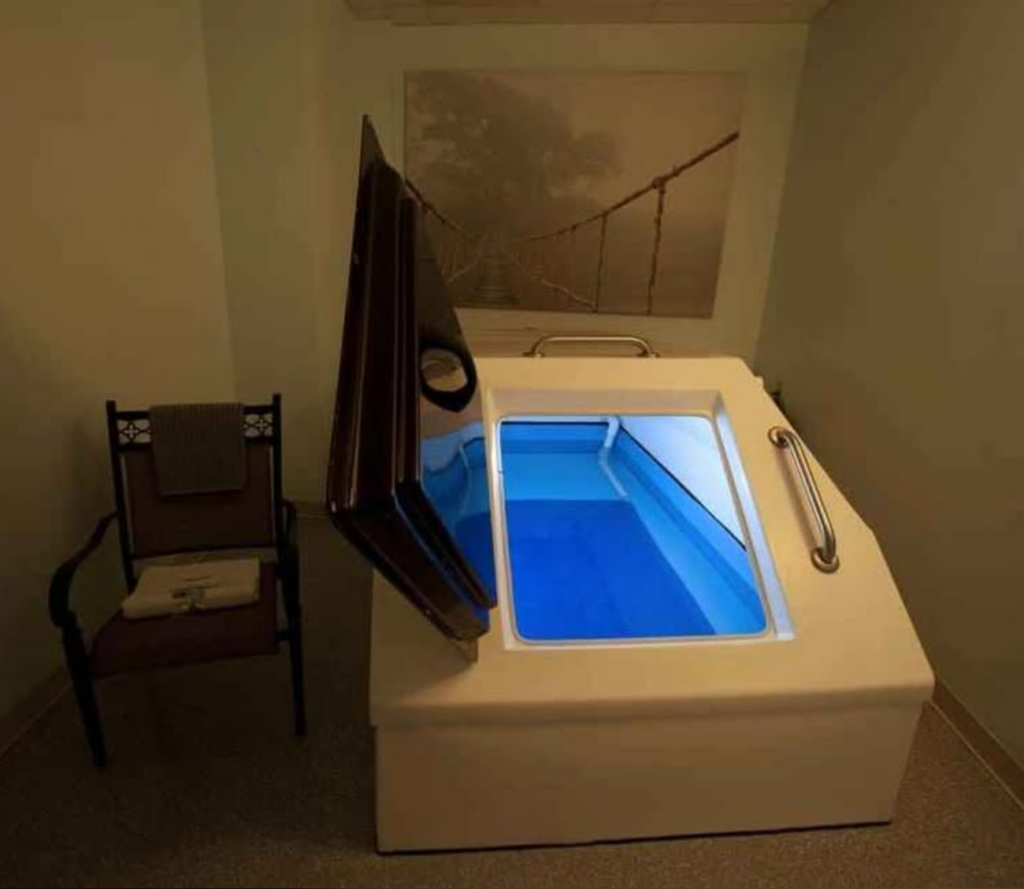
Technically the float room is supposed to be barren and not suggest anything to the floater. But I’m impressed with this image behind the tank… beautiful tile shower complements it nicely as well:
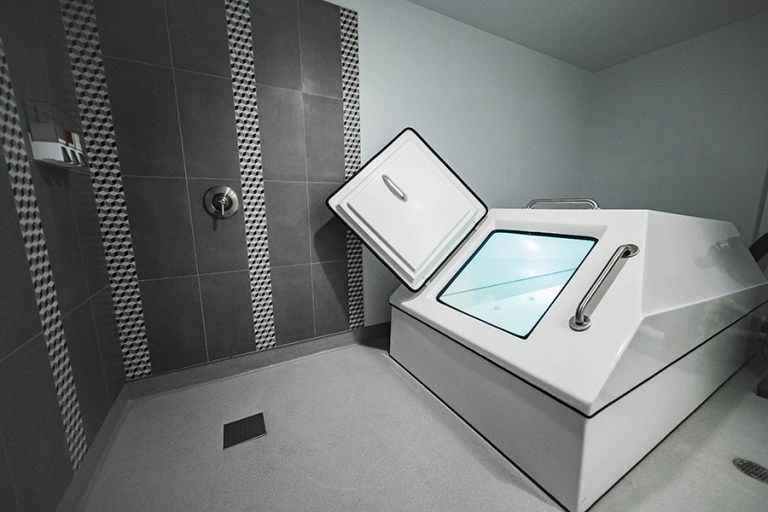
Technically the float room is supposed to be barren and not suggest anything to the floater. But I’m impressed with this image behind the tank… beautiful tile shower complements it nicely as well:
Most people enter a float tank with an unconscious idea of how their body is “supposed” to lie. We mimic the posture we’ve seen in beds, spa ads, even open-casket funerals: head straight, chin up, neck neatly centered, facing the ceiling like a showroom mannequin.
But here’s the truth no one tells you:
That posture is not natural. It’s performed.
If you let your body actually relax—truly, fully, without trying to look like anything—your head doesn’t stay centered. The neck isn’t a rigid pole. When the muscles release, the head naturally rolls off to the left or the right. It “flops,” gently, like a book settling on a table.
And that flop is the doorway into much deeper float states.
Your nervous system has a lifetime of conditioning telling it to hold the head in a “presentable” position. Whether it’s etiquette, photography, or the silent cultural imagery of how bodies lie in beds, we are trained to keep the head forward and centered. Even in sensory deprivation, that conditioning lingers.
It’s only when you consciously invite the neck to let go that you discover how much tension you were unknowingly carrying.
There’s also a subtle physiological reason that letting your head roll to the side deepens the float:
You’re freeing the vagus nerve.
This long wandering nerve runs down each side of the neck, just beneath the major muscles that tighten when you try to hold your head perfectly straight. When you release that “presentation posture,” those muscles stop guarding, and the vagus nerve becomes less compressed and more responsive.
And in the world of inner stillness, the vagus nerve is one of the body’s most important gateways. Some describe it almost like a bridge between the physical and the subtle—a channel that tells the whole system, “It’s safe to soften now.”
When you let your head truly fall to one side:
This is why many floaters feel a sudden internal “drop,” as if the mind has slipped beneath the surface of itself. That’s the nervous system downshifting into deeper awareness.
If the vagus nerve represents the body’s gateway to deep relaxation, then death is the ultimate illustration of surrender—the point at which all tension, all habit, all effort to “hold on” ceases. Observe any naturally deceased body, and you’ll notice a striking detail: the head rarely stays perfectly centered. Instead, it tilts gently to one side, resting wherever the neck and gravity allow.
This is not a macabre curiosity—it’s a profound clue about the body’s natural mechanics. When the muscles finally release without effort, the head flops. Every spine straightening instinct, every cultural “presentation posture,” disappears. The body returns to its most honest, unguarded alignment.
In a float tank, when you let the head fall, even just slightly, you are—briefly and safely—recreating this surrender. You are giving your nervous system permission to release the habitual tension that keeps you upright, alert, and postured. The parallel is striking: the same natural alignment you see in a body at rest in death is mirrored in the body at rest in water.
Floating becomes not just a physical experience but a meditation on impermanence and surrender. The flop of the head is a small, tangible echo of the ultimate letting go—a reminder that relaxation is the natural state when the body and mind stop trying to perform.
This fear keeps a lot of people stuck in a pseudo-relaxed pose.
But when your head rolls slightly to the side, the naturally closed eyes keep the salt out